

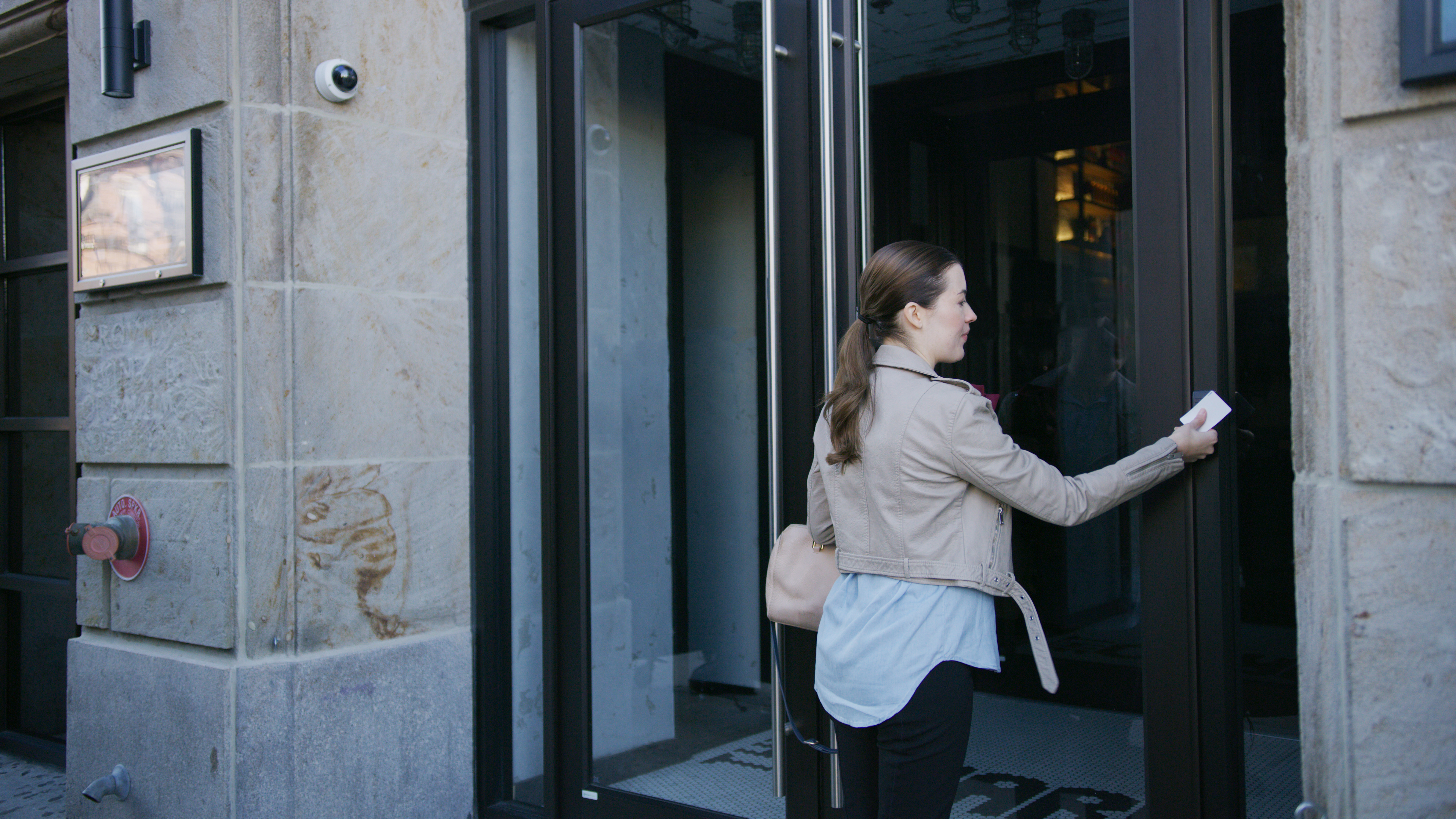
How do people enter your community?
That’s what an access management system determines at multifamily properties. It determines who can open each door and when. The goal is to make sure the right people get in the right place at the right time.
- The right people: Residents, staff, approved vendors, and guests, but no one else.
- The right place: Specific doors each person can access, but not the ones they shouldn’t.
- The right time: Whether a lease term or a maintenance window, access starts and ends exactly when it should.
That granular level of control is difficult with physical keys and static codes that can be shared or copied. Modern access control takes advantage of connected access devices that enable property owners to issue, change, and revoke credentials from anywhere.
With access control, residents and staff use credentials like PIN codes, key fobs, badges, and mobile credentials to get keyless entry into the building, their unit, amenity spaces, and more.
Without modern access management, organizations must deal with frustrating operations and security gaps like:
- Rekeying locks.
- Manually adding and removing user access every time a unit turns.
- Remembering to remove a credential for a contractor.
Instead, these actions can be automated to sync with events like resident move-in/move-out or maintenance windows. Plus, these devices track attempted and successful entries so property teams get detailed data and security records of who is entering their properties.
What is covered by an access control plan?
Apartment access control improves security and convenience by centralizing user access, permissions, and privileges in one place, so organizations can allow controlled access by role and keep security consistent across buildings.
An access plan at a multifamily community can cover areas like:
- Building and perimeter entrances
- Amenity spaces such as gyms, pools, and lounges
- Parking and vehicle gates
- Mail and package rooms
- Elevators
- Unit entry doors
The benefits from two seats: NOI and operations
Access control pays off in the bottom-line and the day-to-day work of property teams.
The NOI perspective: What can you stop paying for?
For asset owners, the clearest return is removing recurring costs associated with keys.
Every unit turn that requires a physical lock change or a new set of keys carries a hard cost that repeats for the life of the property. Digital credentials end that cycle by resetting codes instead of rekeying locks.
Additionally, organizations save the labor hours spent cutting keys, tracking who has which fob, and driving to a property to let a vendor in. Centralizing all of that into a single access control system gives those hours back and makes access management easier and more secure.
The operations perspective: What can your team stop doing manually?
Operationally, organizations move from reacting to individual access requests to overseeing user access for every building in the portfolio from one dashboard.
- Residents can get where they need to go on their own (into the building, their unit, and the amenity spaces) with keyless entry.
- Maintenance techs and vendors can be let in remotely to the exact place they’re needed without a staff member physically present to open a door.
- Leasing agents can show prospective residents the exact units they’re interested in without running back to the office to get a key.
Keyless entry systems and smart locks enable convenient and secure access for the entire community.
The compounding value of building-wide access + unit-level access
Most organizations begin with building-level access: secured entrances, controlled access to amenities, gated parking, and a logged mailroom.
Extending apartment access control to the unit is where the resident experience becomes seamless.
Residents can get into their unit and every amenity space using the same code across the entire property, eliminating the need to carry a key or a fob.
Management sees an audit trail of access data, showing who accessed each door.
A combined access control system can also contribute to additional revenue by making leasing easier and more secure.
Instead of showing a demo apartment, leasing agents can find a vacant unit with the exact layout the prospect is looking for and open it on the spot with keyless entry No more walking back to the office to find the right key.
The tour keeps its momentum, the prospect gets a personalized experience, and the agent spends their time selling the space rather than managing keys.
Additionally, a connected access control system makes it possible for properties to expand leasing hours using self-guided tours. With self-guided tours, ID-verified prospects can tour the building, amenity spaces, and unit using a temporary PIN that only works while they’re on the property.
Where keys, fobs, and manual credential management fall short
Physical keys and shared fobs create security gaps that become worse at scale for rental portfolios.
A key or fob can be lost or copied. Every copy in circulation is a door you no longer fully control, and there’s no easy way to revoke a physical credential once it’s out there.
That security exposure grows with every turn. A single turn can involve:
· Cleaners
· Painters
· Maintenance techs
· Inspectors
· Leasing staff
· Prospects
Each group needing user access to the unit for a short window.
Giving keys or static codes to each of them, and remembering to collect or disable each one afterward, is hard to manage and increases security risk.
Instead, consider a unit turn that uses an access plan with connected hardware. You may have a painter who needs to get in on Thursday.
Using your access control system, you issue a code that works for that unit and expires at the end of the workday. No one drives out to meet the painter with a key, the door auto-locks at the end of the day, and no code lingers after the job is done.
With keyless entry systems, organizations can allow user access to specific areas based on roles, time, and policies, so privileges and permissions don’t extend beyond what is necessary.
Connectivity that holds up: Cellular, Z-Wave, and backup paths
The security and convenience benefits of a connected access management system only actualize with stable and dependable connectivity.
Many cloud-based systems rely on Wi-Fi or ethernet connection. PointCentral uses cellular as the primary connection, with Wi-Fi and ethernet as backups. This layered approach means that access continues operating without interruption; even in situations where the building’s internet goes down.
Cellular connectivity is stable, efficient, and simplifies installation at properties where running ethernet or maintaining a robust Wi-Fi network isn’t practical. For example, a parking garage with insufficient Wi-Fi, or a garden-style community where buildings are widespread across the property.
Devices on-site communicate locally using Z-Wave technology. This format makes PointCentral compatible with other manufacturers (explained more below) and enables access readers and smart locks to interact directly with hubs on the property instead of competing to route every action through the building’s internet.
Automations and integrations: where the manual work disappears
The NOI of access control compounds when organizations can connect the access control system to the systems the property already uses. That’s where PointCentral’s unified platform shines.
Property management system (PMS) integrations
By integrating access control with your property management system, the move-in and move-out you already perform in the PMS automatically changes access credentials based on policies.
Complete a move-in, and the new resident’s access to their unit and amenity spaces is automatically provisioned. Complete a move-out, and that access is revoked at the reader and the lock, so no user can enter a property they’ve left. The access control system enforces policies at the door and logs access data for security.
- Move‑in automation: create resident credentials across the property, remove vacant‑unit settings, and send the welcome email.
- Move‑out automation: automatically deactivate unit access, remove amenity access, and apply vacant-unit thermostat settings.
- Work‑order access: generate temporary, time‑bounded codes from a work order; codes expire at the end of the day.
- Bulk move‑ins/outs: provision batches of units from the dashboard in minutes while keeping permissions consistent.
PointCentral integrates with over 30 major property management systems, including Yardi, RealPage, Entrata, AppFolio, ResMan, and RentManager. For organizations managing multiple buildings, consistent access management reduces training burden and keeps user access policies uniform across the portfolio.
Choose from curated hardware options: a tested ecosystem of access control solutions
PointCentral runs on open standards like Z-Wave rather than a closed proprietary stack. We integrate with smart locks, readers, and intercoms from established third-party brands.
Every device in our ecosystem is rigorously tested to be compatible with our platform. It’s not a simple connection, but a true integration. For apartment access control, that means the access control system can keep the same authentication and authorization workflow even when locks and readers vary. That hardware flexibility makes it so operators aren’t forced to rip out hardware that already works, and aren’t locked into a buying products from a single vendor.
Access control as the foundation of one smart IoT platform for your entire portfolio
Access control is the foundation that modern smart property technology is built on. It puts the infrastructure in place to connect solutions that share the same users and the same events.
This is where organizations benefit from implementing a scalable and connected platform rather than a dashboard of integrations.
The PointCentral platform includes solutions for access control, video monitoring, intercom solutions, energy management, leak detection, and a resident app. By centralizing these solutions in one dashboard, you unlock benefits like:
- Access and video: When access events and cameras live on the same platform, every door opening becomes a bookmark into your footage, improving security monitoring. Instead of scrubbing hours of continuous video, you jump straight to the clip from the moment a door was opened, so reviewing who entered the package room or an amenity space becomes a lookup rather than a search.
- Access and intercom: Pairing access control with a video intercom enables residents to grant entry to visitors without having to meet them in the lobby. No front desk buzz-in required.
- Access and the resident app: With access control in their app, residents can create a temporary code for a cleaner or a dog walker and lock or unlock their own door remotely.
How PointCentral approaches apartment access control
PointCentral access management is built to get the right people in the right place at the right time, and to make that easy for organizations to run across a portfolio. Every access point, from the building’s shared doors to the unit, is managed centrally with credentials you issue and revoke remotely from your PMS.
Our hardware ecosystem includes many popular access readers, intercoms, and smart locks brands, and our cellular-first architecture, with Wi-Fi and ethernet backup, ensures systems stay connected and secure.
We are built on Alarm.com’s infrastructure of smart property technology. Trust the reliability of a publicly traded company that scales across entire portfolios and brings together point solutions into a single dashboard for owners and operators. All our customers are supported by local service providers who help with design, installation, and support.
If you’re weighing access control for your portfolio, set up a demo today.
Frequently asked questions
What is access control for multifamily properties?
It’s the connected hardware and software—an access control system—that manages who can enter which doors on an apartment property, from building entrances, amenities, gates, and mailrooms to unit doors, and keeps a record of that access as security data. It replaces physical keys and static codes with credentials you can issue and revoke remotely with keyless entry systems.
What are the main benefits of access control for apartments?
It removes the recurring cost of rekeying at turns, gives staff back the hours they spend managing keys and letting people in, lets residents and approved vendors reach the right places with controlled access and proper authorization, and creates a logged record of entry as security data across the property. Owners tend to feel it in operating cost, and on-site teams feel it in day-to-day workload.
Do most operators use access control for the building or the unit?
Many organizations start at the building level – securing shared entrances, amenities, gates, and mailrooms – and extend apartment access control to unit doors from there. The value compounds when both layers run on one access control system, because credentials, logs, policies, and turnover are managed in a single place with consistent authentication.
How does PointCentral access control help with unit turns?
First, resident access is automatically revoked. You can issue time-limited codes for each vendor a turn requires—a cleaner, a painter, a maintenance tech—that work only when they should and expire on their own, enforcing authorization and security. Nobody meets them with a key, nobody drives out to let them in, and no code lingers after the job is finished. Keyless entry systems and smart locks keep the process secure while improving convenience for tenants and staff, because authorization is time-bounded, and access data shows exactly who entered. Lastly, credentials across the property are automatically granted to the new resident at move-in.
Does PointCentral access control integrate with my property management software?
Most likely, yes! PointCentral integrates with major property management systems including Yardi, RealPage, Entrata, AppFolio, ResMan, and RentManager. Move-in and move-out performed in the PMS can provision and revoke access automatically.
Can I keep my existing locks and readers?
Often, yes. PointCentral offers popular Alarm.com devices and also works with established third-party hardware through open standards like Z-Wave, so organizations are frequently not forced into a full hardware replacement. Confirm compatibility for your specific devices during evaluation.